
How Multi-Chambered uPVC Profiles Reduce Indoor Heat in Indian Homes
A multi-chambered uPVC profile is the frame of a window or door, made of Unplasticized Polyvinyl Chloride. This uPVC profile features multiple hollow sections inside, which trap air to create strong insulation barriers. This makes your home highly energy-efficient and secure.
Selection of windows stars with glass and design aesthetics, but there is another important element that determines how comfortable a room feels on a day.
Even the best-performing glass fails if the frame allows heat transfer. This is the reason why modern window engineering is focusing more on insulation and performance rather than aesthetics. And, one among them is the multi-chambered uPVC profile.
Contents
- 1 What is a Multi-Chambered uPVC Profile?
- 2 Why Window and Door Frames Influence Indoor Temperature
- 3 How the Multi-Chamber Profiles Help Reduce Heat Transfer
- 4 Why Air Chambers Work Better Than Solid Section
- 5 Understanding Chamber Count: Is More Always Better?
- 6 Benefits of Multi-Chambered Profiles
- 7 Multi-Chambered uPVC vs Conventional Frame Systems
- 8 What Should You Ask Before Buying uPVC Windows?
- 9 Conclusion
What is a Multi-Chambered uPVC Profile?
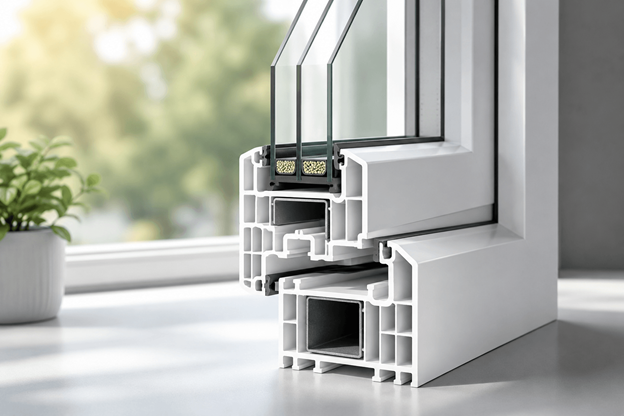
If you cut open the uPVC window frame, you will see multiple enclosed sections running through the profile called chambers. These multi-chambered profiles do not appear from the outside because they are present inside the frame. They are engineered to improve:
- Thermal insulation
- Sructural stability
- Wind resistance
- Acoustic performance
- Long-term dimensional consistency
Why Window and Door Frames Influence Indoor Temperature
It is a common misconception that heat enters only through glass, but a window and door work as a complete system. So, every component of them passes heat inside.
When external surfaces heat up, heat naturally begins moving toward cooler indoor environments. This transfer occurs continuously through:
Conduction– Heat moves through solid materials like frame and glass
Convection– Heat is carried through the movement of air around the window and door surfaces
Radiation– Heat transferred through solar energy and warmed exterior surfaces
If the frame conducts heat soon, indoors, see faster temperature fluctuations, increased reliance on ACs, and spaces feel warmer near the window or door zones.
How the Multi-Chamber Profiles Help Reduce Heat Transfer
Multi-chambered uPVC profiles are engineered to slow down heat transfer through the window frame. It means the frame does not stop the heat transfer completely, but it reduces the speed.
Multiple enclosed chambers are created using internal uPVC walls, which trap pockets of air within the profile structure.
Air is naturally a poor conductor of heat, so it does not transfer thermal energy quickly. As heat reaches the outer surface of the frame, it cannot move directly indoors and will pass through multiple layers:
- Outer uPVC Wall
The outer layer of the frame absorbs exposure from the external environment. - Air Chamber
At this stage, heat encounters a sealed pocket of air. The trapped air reduces the speed of heat transfer. - Internal uPVC Wall
Heat then passes through another uPVC wall before reaching the next section. - Additional Air Chambers
Every chamber in the profile creates another heat interruption, slowing down the transfer of heat.
This means your space stays cooler in summer and warmer in winter.
Why Air Chambers Work Better Than Solid Section
Because a solid window or door frame has more material, it may initially seem stronger. However, a solid piece isn’t always the best option when it comes to thermal insulation. Solid naturally absorbs heat, making it easy for heat to move inside.
Understanding Chamber Count: Is More Always Better?
Window and door profiles are available in different configurations like 3-chamber, 5-chamber, or 7-chamber designs. But it doesn’t mean that having more chambers means better insulation.
But that is not always true; the number is only one part of the overall profile design. Beyond a certain point, increasing chamber count does not guarantee noticeable performance improvement. This is where the engineering plays a crucial role, as several factors need to work together to determine the window performance.s
Chamber Geometry
How efficiently the heat transfer is reduced depends on the size, shape, and arrangement of chambers. They influence how effectively the air is trapped inside.
Profile Wall Thickness
Dimensional stability, long-term durability, and structural strength are all impacted by the thickness of the uPVC walls.
Reinforcement Design
For large window and door sizes, internal reinforcement helps in maintaining the profile’s stiffness and structural performance.
Sealing System
If air leaks due to poor gasket design or insufficient sealing, even a high-chamber profile may function poorly.
Glazing Compatibility
To achieve balanced thermal performance, the profile and the glass standard must work together with the profile.
Fabrication and Installation Quality
To get the desired results on site, a well-designed profile still needs to be manufactured and installed correctly.
For this reason, chamber count should never be the sole consideration when choosing a professional window.
A badly constructed profile with more chambers can frequently be outperformed by a well-engineered 5-chamber system.
The entire system, like profile design, reinforcing, glazing, sealing, fabrication, and installation, must work together to produce uPVC windows and door systems.
Benefits of Multi-Chambered Profiles
Though one of the main benefits of multi-chambered uPVC profiles is thermal insulation, the internal chamber design influences a number of other aspects of window performance.
More Stable Indoor Conditions
The areas close to windows and doors can feel different from the rest of the space. This happens because openings are one of the main points where external conditions interact with indoor spaces.
This impact is lessened by multi-chambered profiles, which impede the flow of temperature through the frame.
This impact is lessened by multi-chambered profiles, which slow the flow of temperature through the frame.
Better Acoustic Comfort
Besides heat, outside noise has an impact on indoor comfort. In multi-chambered profiles, the internal chamber acts as a sound barrier inside the frame. This offers a calmer and more comfortable indoor environment when combined with suitable glazing and sealing systems.
Protection Against Outdoor Conditions
Window frames are constantly subjected to changing external factors, such as wind, rain, humidity, and temperature fluctuations. The chambered internal structure improves overall profile performance by helping maintain dimensional stability and supporting long-term functionality.
Enhanced Structural Stability
The purpose of multi-chambered profiles is not limited to enhancing insulation. The profile’s internal walls strengthen and stabilise the frame by improving support throughout. This improves rigidity and helps maintain the shape.
Reduced Maintenance
uPVC profiles are made for long-term usage with little upkeep, in contrast to materials that could need regular surface cleaning, repainting, or corrosion protection. In most cases, regular cleaning is adequate to preserve performance and appearance.
Supports Modern Building Performance
Today’s modern buildings are expected to deliver more than aesthetics.
Windows and doors are being selected based on thermal performance, durability, weather resistance, and lifecycle value.
Multi-chambered profiles support these performance expectations by integrating insulation, structural efficiency, and long-term usability into a single system.
Also Read: All That You Need do Know About uPVC Windows Multi Chamber
Multi-Chambered uPVC vs Conventional Frame Systems
| Parameter | Multi-Chambered uPVC | Conventional Frame Systems |
|---|---|---|
| Thermal Resistance | Higher | Moderate |
| Indoor Temperature Stability | Better | Standard |
| Weather Performance | Improved | Variable |
| Maintenance Requirement | Low | Moderate |
| Structural Efficiency | High | Standard |
What Should You Ask Before Buying uPVC Windows?
Before choosing uPVC windows, ask these questions:
- How many chambers does the profile have?
- Is the profile reinforced for strength?
- What type of glass options are available?
- How effective is the sealing system?
- Will installation be taken care of by trained professionals?
Conclusion
Selecting the ideal window is more than just a design choice. Long-term comfort and building performance can be significantly improved by understanding the profile design, insulation performance, and overall system quality.
Multi-chambered uPVC profiles are designed to do more than hold the glass. The multiple internal chambers help reduce heat transfer and support a more comfortable indoor environment.
Aparna Venster designs uPVC window and door systems that combine smart engineering with everyday comfort. If you are looking for window and door systems with high performance, get in touch today.
Q1: Do multi-chambered profiles completely stop heat transfer?
No, they do not block feat entirely. They slow it down by acting as a thermal insulator. No window or door design will completely block the heat.
Q2: Are multi-chambered uPVC frames high-maintenance?
No, they can be cleansed occasionally. Multi-chambered uPVC frames can be cleaned with a soft cloth and soap and water. No repainting or other types of coatings are needed.
Q3: What makes installation critical to profile performance?
In order to prevent structural warping under wind load, stop perimeter air and water leaks, and preserve exact hardware alignment for smooth operation, proper installation is crucial.
 English