
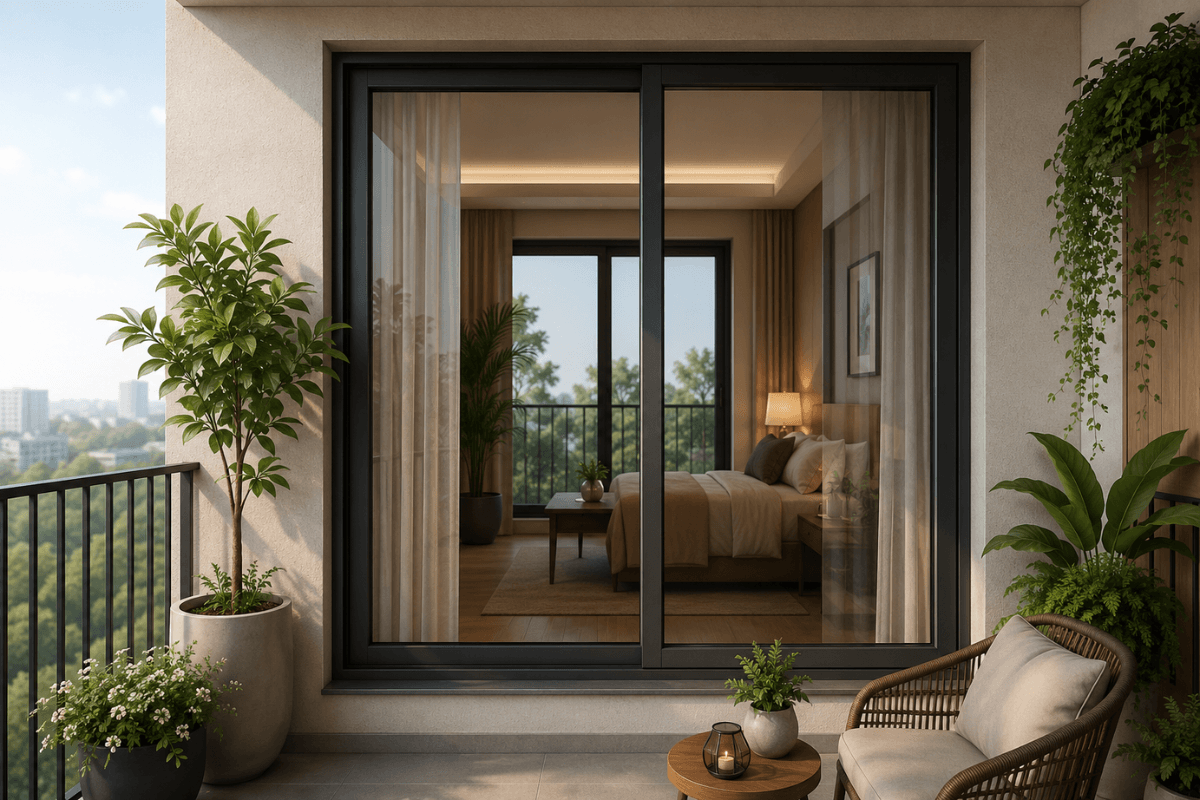
11 Balcony Window Designs That Actually Suit Indian Balconies
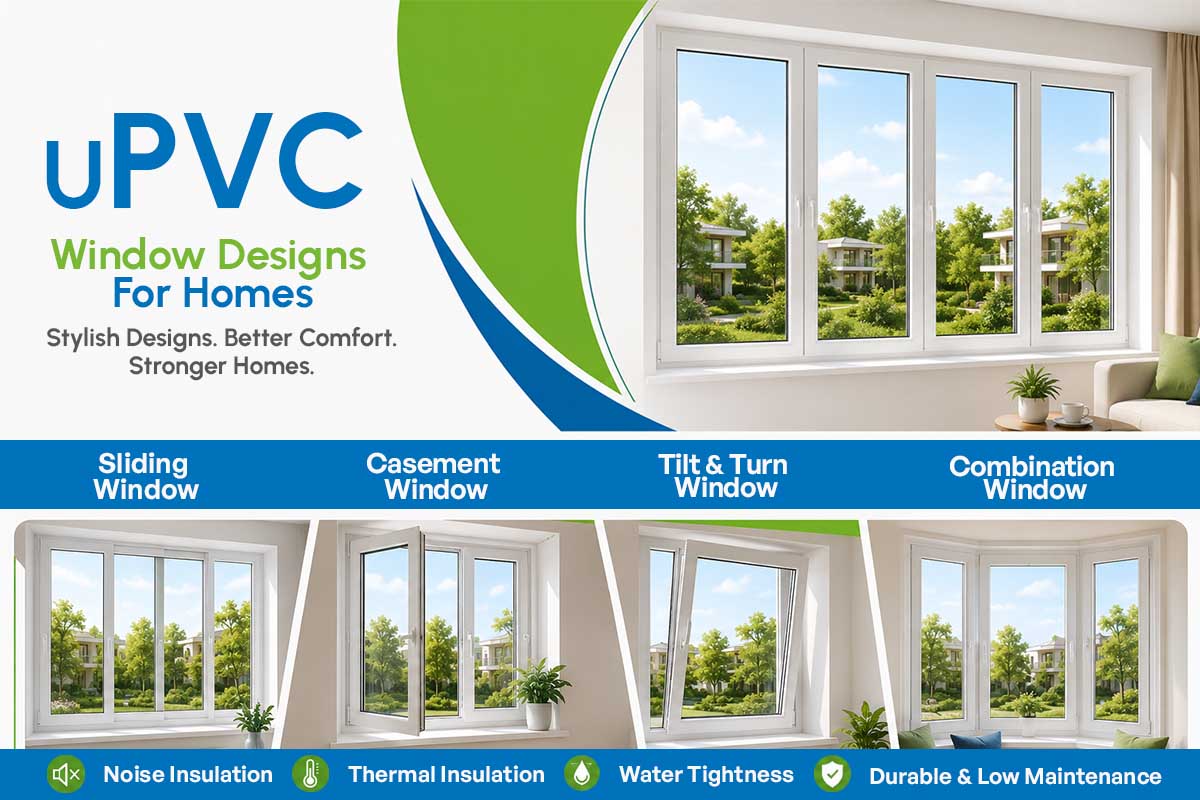
For small city balconies, a sliding uPVC window is usually your best bet. It requires no swing space and still lets in full light. For bigger balconies where you want maximum airflow, go with casement or tilt-and-turn windows instead. The right choice really comes down to three things – how much space you have, how much ventilation you need, and which direction your balcony faces.
List of styles with vague tags like modern or elegant doesn’t t help you. This wiret up dicsusess 11 window styles that actually matters. They are space, airflow, sun exposure, noise, and upkeep.
Contents
- 1 1. Sliding Windows
- 2 2. Floor-to-Ceiling Sliding Windows
- 3 3. Sliding Windows With Fixed Side Panels
- 4 4. Casement Windows
- 5 5. French-Style Balcony Windows
- 6 6. Corner Windows
- 7 7. Tilt-and-Turn Windows
- 8 8. Villa-Grade Windows
- 9 9. Multi-Panel Sliding Windows
- 10 10. Black-Frame Windows
- 11 11. Combination Windows
- 12 Quick-Pick Window Guide
- 13 Three Mistakes Worth Avoiding
- 14 Why Aparna Venster
- 15 Frequentkly Asked Questions
1. Sliding Windows
Good for: Balconies under 6 feet wide, or any apartment where floor space is tight.
Sliding panels move on a horizontal track instead of swinging outward, so you don’t lose any usable balcony space to an open window. A two-track slider with toughened glass is the standard configuration. You can add a mosquito mesh track if you are close to greenery.
2. Floor-to-Ceiling Sliding Windows
Good for: Living rooms that open directly onto a balcony.
These extend from floor level to the ceiling instead of stopping at chest height, so the boundary between your living room and balcony almost disappears. In hotter months, combine this with a low-E (heat-reflective) glass coating. Or else, a west-facing full-height window can raise room temperature by afternoon.
3. Sliding Windows With Fixed Side Panels
Good for: Wide balcony openings where you want a big glass view but only need to open one section.
One sliding sash sits in the middle, flanked by fixed glass panels on either side. You get ventilation exactly where you need it, without paying for hardware (rollers, locks) on glass that will rarely open.
4. Casement Windows
Good for: Independent houses and villas, especially where cross-ventilation matters more than street noise.
The entire sash swings outward on hinges, opening the full window area roughly double the airflow of a uPVC sliding window of the same size. They need external clearance to swing open, so they don’t work well on narrow balconies or where a railing sits close to the frame.
5. French-Style Balcony Windows
Good for: Balconies with at least 3 feet of clearance in front, where the balcony functions more like an extra room.
Two casement shutters open outward from the centre, similar to a double door. This works well when the balcony is deep enough for seating, but it’s the wrong choice for a narrow utility balcony. The shutters need room to swing without hitting a chair or clothesline.
6. Corner Windows
Good for: Corner units or apartments with views on two sides.
Glass wraps around two adjoining walls with a structural mullion (vertical joint) at the corner instead of a solid wall. Ask for a slim-profile uPVC frame here specifically beciuase a thick frame at the corner interrupts the view.
7. Tilt-and-Turn Windows
Good for: Upper-floor apartments and households with young kids or pets.
The sash can either tilt inward from the top (for secure, gap-only ventilation) or swing fully open on a side hinge. The tilt position lets air in during light rain without anyone needing to be shut it, and it’s harder for a child to climb through than a fully open casement.
8. Villa-Grade Windows
Good for: Larger openings (6+ feet) in independent houses.
These use reinforced uPVC profiles rated for bigger glass panels, as standard residential frames can start to sag or bow at wider spans. If your balcony opening is unusually large, check the frame’s load rating before ordering.
9. Multi-Panel Sliding Windows
Good for: Balconies used as an extension of a living or dining area.
Three or four panels run on multiple tracks instead of the standard two, so a larger share of the wall can open at once. Useful if you actually walk in and out through this opening regularly, rather than just looking through it.
10. Black-Frame Windows
Good for: Homes with light-coloured exteriors wanting a contemporary look.
This is a finish choice, and any of the styles above can be ordered in a black or dark-grey uPVC frame. Dark frames absorb more heat than white ones, so in sun they can warm up more at the frame edge.
11. Combination Windows
Good for: Balconies where one section needs airflow and another just needs a view.
Mixing a sliding or casement section with fixed panels lets you place ventilation exactly where airflow actually reaches the room, instead of making every panel operable by default.
Quick-Pick Window Guide
| Priority | Best Design | Why |
| Tight space | Sliding | No swing room needed. |
| Max airflow | Casement | Entire window opens wide. |
| No-draft breeze | Tilt-and-turn | Tilts at top for safe air. |
| Hot afternoons | Low-E glass | Blocks heat, keeps light. |
| Corner view | Slim corner frame | Uninterrupted panorama. |
| Deep balcony | French style | Full walk-through opening. |
| Child safety | Tilt-and-turn | Top-tilt prevents falls. |
| Wide balcony | Multi-panel slider | Maximizes usable opening width. |
Three Mistakes Worth Avoiding
1. Picking a style without measuring: French and casement windows need the sash to open outward without hitting a railing, chair, or drying stand. So alway measure first.
2. Do not ignore balcony facing: A west-facing balcony takes direct sun for hours in summer. So what mattes here is glass coating you need, not just which frame style looks good.
3. Judging a window by the frame alone: Two windows can look identical and perform very differently based on the rollers, hinges, and locking hardware inside. Ask what hardware brand is used before comparing prices.
Why Aparna Venster
Aparna Venster builds uPVC windows engineered to handle harsh climate. Every design above can be designed suit your balcony’s exact opening and finishes that matches your façade.
Here’s why you need to choose Aparna Venster:
- German Technology
- Lead-free profiles
- End-to End service
- No third party involvement
- Ensures quality control
- Usage of Titanium dioxide and calcium zinc stabilisers
Frequentkly Asked Questions
Which balcony window is best for small apartments?
A sliding window is usually best for small apartments because it doesn’t need any outward swing space, so it works even on narrow balconies.
Which balcony window gives the most ventilation?
A casement window gives the most ventilation because the entire sash swings open, roughly doubling the airflow of a sliding window of the same size.
Are floor-to-ceiling balcony windows safe for high-rise apartments?
Yes, with toughened safety glass and a properly rated frame. For upper floors, pair the design with a railing or grille and ask your installer about wind-load ratings for your building’s height.
Which window design needs the least maintenance?
Sliding uPVC windows generally need the least maintenance — occasional track cleaning and lubrication are usually enough, since uPVC doesn’t need repainting or rust treatment.
Can I mix window styles on the same balcony?
Yes. For example, a sliding section for airflow and a fixed panel for view is common where you want ventilation in one specific area rather than across the whole opening. Sliding and Fixed = Combination window.
Does frame colour affect how hot a window gets?
Slightly. Darker frames absorb more heat than white or light-coloured ones in direct sun, though the difference mainly affects the frame surface, not indoor temperature — glass coating matters far more for heat gain.
Related posts:
 Latest uPVC Bathroom Door Designs for Indian Bathrooms
 Top 10 Bathroom Window Design Ideas for Indian Homes
 How Multi-Chambered uPVC Profiles Reduce Indoor Heat in Indian Homes
 uPVC Window Designs for Homes: Types, Benefits and Buying Guide
 Hidden Costs in Window Quotations: What Most Homeowners Don’t Know
 English