
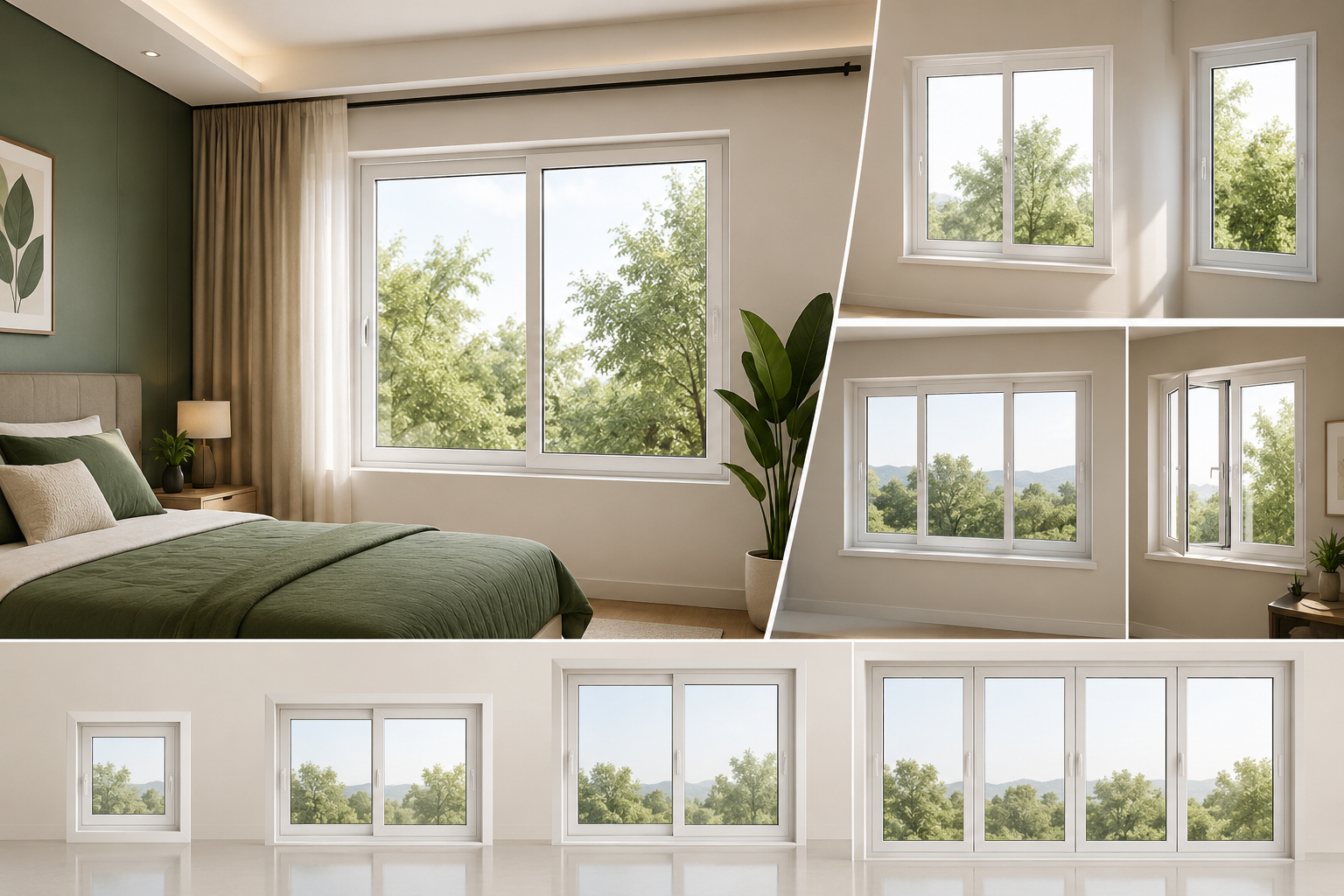
Bedroom Window Sizes Explained: A Complete Guide (2026)
Choosing the wrong window size for your homes is one of the most common mistakes homeowners make while constructing or renovating your home.
If your window is too small, the room feels dark and stuffy. And if too large, windows will compromise privacy, may increase heat, and increase your electricity bills. If you select the right size, your spaces become comfortable.
But many homeowners neglect this and leave the choice to the builder or contractor, who just selects the windows that are easy to source.
This guide explains standard bedroom window sizes used in India, the factors that influence the right choice, how different room types need different sizes, and how uPVC systems offer the flexibility to get it exactly right.
Contents
- 1 Standard Bedroom Window Sizes in India
- 2 Check this reference for standard bedroom window sizes in Indian homes:
- 3 Factors That Influence Bedroom Window Size Selection
- 4 Ideal Bedroom Window Sizes for Different Room Types
- 5 Popular Bedroom Window Styles and Their Standard Sizes
- 6 Window Placement: Height, Width & Positioning Tips
- 7 uPVC Bedroom Windows: Size Flexibility and Customisation
- 8 Key customisation options available in uPVC bedroom windows include:
- 9 Common Mistakes to Avoid When Choosing Window Sizes
- 10 Same size for all bedrooms:
- 11 Maintenance Tips for Bedroom WindowsKeeping bedroom windows in good condition requires minimal effort when done regularly.Frame cleaning:
- 12 Frequently Asked Questions
Standard Bedroom Window Sizes in India
In India, bedroom window sizes follow industry standards to balance ventilation, light, and privacy.
The most commonly standard bedroom window size is 4 ft × 4 ft (1200mm × 1200mm). This works well in apartments and independent homes and is widely available across window manufacturers and fabricators.
According to standard residential planning guidelines, the bedroom window size must be 4 × 4 ft (1219 × 1219 mm). Also, the window sill height is 2 — 2.5 ft from the floor for bedroom and living room.
The National Building Code of India (NBC 2016) does not prescribe a window size for bedrooms but it has set a minimum requirement.
As per the National Building Code (NBC), the minimum aggregate area of window openings for living rooms must be at least 1/10th (or 10%) of the floor area.
Check this reference for standard bedroom window sizes in Indian homes:
Bedroom Type | Standard Window Size (ft) | Size in mm |
Small Bedroom | 3 ft × 3 ft | 900 × 900 mm |
Standard Bedroom | 4 ft × 4 ft | 1200 × 1200 mm |
Master Bedroom | 5 ft × 4 ft or 6 ft × 4 ft | 1500 × 1200 mm or 1800 × 1200 mm |
Kids’ Bedroom | 3 ft × 3 ft or 4 ft × 3 ft | 900 × 900 mm or 1200 × 900 mm |
Factors That Influence Bedroom Window Size Selection
There are numerous factors that affect the size of the bedroom window. Let’s understand those factors in this section:
Room size and floor area:
As per NBC’s 1/10th rule, larger rooms require larger window openings. A 100 sq ft master bedroom requires at least 10 sq ft of window area. This means a bedroom can accommodate one or two windows.
Orientation and sunlight direction:
The facing of your home also affects the size of a window. For instance, a bedroom facing west receives more heat in. So it is preferable to have a smaller window.
Floor level and privacy:
Ground floor and lower floor bedrooms require careful sizing. A too large window can compromise privacy. So a higher sill height (3ft) addresses these issues without compromising on ventilation.
Cross ventilation requirements:
Windows on adjacent or opposing walls should be taken into consideration simultaneously for natural ventilation. Light is provided by a single huge window without an opposing entrance, but ventilation is not.
Vastu and architectural guidelines:
Many Indian homes adhere to Vastu principles. This suggests particular window sizes and directions for bedrooms. For bedrooms, windows facing north and east are usually favoured since they let in early light without becoming too hot in the afternoon.
Local climate zone:
Different window sizing techniques are required for each temperature zone. Smaller, well-shaded apertures are beneficial in hot areas like Rajasthan and some portions of Gujarat. Larger apertures are necessary for airflow in warm, humid regions like Kerala and coastal Maharashtra.
Ideal Bedroom Window Sizes for Different Room Types
1. Small Bedrooms
Compact 2BHK and 3BHK flats in Indian cities frequently include small bedrooms, usually less than 100 square feet.
The normal recommendation for these rooms is a window that is 3 feet by 3 feet (900 mm by 900 mm). In tiny rooms, closets and beds offer minimal wall flexibility, so it fulfills NBC ventilation needs and also maintains the wall area for furniture layout.
A 4 ft x 3 ft (1200 mm × 900 mm) sliding window is a useful addition that still fits within narrow wall limits if natural light is important.
A small bedroom should not be larger than 4 feet by 4 feet because this will diminish usable wall space and, if the room is on a lower floor, may cause privacy difficulties.
2. Medium-Sized Bedrooms
The most typical bedroom size in Indian homes is a medium bedroom, which is between 100 and 140 square feet.
This is a good place for the typical 4 ft × 4 ft (1200 mm × 1200 mm) window. It satisfies ventilation needs, offers sufficient natural light, and has ample wall space for typical furniture arrangements.
A 5-by-4-foot (1500-by-1200-mm) window is a valuable addition for bedrooms that face either north or east. More morning light is brought in by the extra width without appreciably raising the thermal burden.
3. Master Bedrooms
Indian independent homes and villas usually have master bedrooms that are at least 150 to 200 square feet in size.
The minimum window requirements increase with floor area. A master bedroom window should be at least 5 feet by 4 feet (1500 mm by 1200 mm) in size. High-end homes typically have windows that are at least 6 feet by 4 feet (1800 mm by 1200 mm).
Instead of having a single huge window, many master bedroom designs now have two windows: a conventional window and a smaller accent window. This enhances cross ventilation and increases design freedom in terms of furniture placement and wall treatment.
A 6-by-5-foot (1800-by-1500-mm) sliding window or a floor-to-ceiling fixed glass panel combined with a smaller movable window is becoming more and more common for homes with views of gardens or balconies.
4. Kids’ Bedrooms
In addition to light and ventilation, children’s bedrooms need special consideration for safety.
The suggested dimensions range from 3 feet by 3 feet (900 mm by 900 mm) to 4 feet by 3 feet (1200 mm by 900 mm). For safety reasons, it is highly advised to raise the sill height to 3.5 feet from the floor, as this lowers the possibility of a youngster reaching or falling through the window.
Regardless of floor level, steer clear of big apertures and low sill heights in children’s bedrooms. For children’s rooms on upper floors, fixed glass panels with a little movable section at the top are a safer option.
Popular Bedroom Window Styles and Their Standard Sizes
1. Casement Windows
Casement windows open outward like doors and are hinged on one side. Because the entire panel opens freely, they offer excellent ventilation.
In India, casement bedroom windows typically measure 3 feet by 3 feet to 4 feet by 4 feet (900 mm by 900 mm to 1200 mm by 1200 mm). Because of the necessary outward swing clearance, larger casement windows that are wider than five feet are less prevalent in bedrooms.
2. Sliding Windows
In India, sliding windows are the most popular type. They don’t need clearance room to open and run horizontally down a track.
Bedroom sliding windows typically measure 4 feet by 3 feet to 6 feet by 4 feet (1200 mm by 900 mm to 1800 mm by 1200 mm). They work especially well in bedrooms with balconies, grilles, or close proximity to walls that make outward-opening windows impractical.
3. Fixed Windows
Fixed windows let light in without ventilation; they don’t open. They are used in conjunction with movable windows to expand the glass area without increasing the amount of heat or noise that enters.
Bedroom fixed window sizes typically range from 2 feet by 3 feet to 4 feet by 4 feet. They function well as accent panels above a typical casement or sliding window, adding extra light while maintaining a manageable size for the movable portion.
4. Combination Windows
Combination windows combine a fixed glass panel with a movable component, usually a sliding unit or casement. This method is used in high-end homes and master bedrooms.
A typical setup is a 4-foot (1200mm) height with a 3-foot fixed panel and a 3-foot movable panel for a total width of 6 feet. This maintains practical and controlled ventilation while creating the illusion of a huge window.
Window Placement: Height, Width & Positioning Tips
Choosing the correct size is only half of the process. Placement has an impact on ventilation, privacy, light quality, and the overall atmosphere of the space.
Sill height for bedrooms: For bedrooms, the typical window sill height is 2 to 2.5 feet (600 to 750 mm) above the floor. This keeps the window at a reasonable height for ventilation when standing or sitting, allowing natural light to penetrate deeply into the space.
Lintel height: In order to match the door lintel height, the top of the window (lintel) should preferably be 7 feet (2100 mm) from the floor. This maximises the amount of glazed space inside the wall and establishes a uniform horizontal line throughout the space.
Centering on walls: Wherever possible, place bedroom windows in the center of the wall. This produces a more balanced elevation from the exterior, evenly distributes light, and facilitates furniture placement.
Distance from corners: Windows should be at least 1.5 to 2 feet away from the corners of internal walls. This prevents condensation problems that arise when glass is too close to a cooler corner surface and preserves structural integrity at the corner junction.
Cross ventilation principle: Windows should be positioned at 90-degree angles or on walls that face one another for optimal airflow. A single window on one wall results in stagnant air, but two windows on separate walls produce a pressure differential that naturally circulates air throughout the space.
uPVC Bedroom Windows: Size Flexibility and Customisation
Most situations may be accommodated by standard sizes, but custom sizes are frequently required for bedrooms with unique proportions, architectural elements, or other design requirements.
Here, uPVC window systems provide a great deal of freedom. Unlike wood or aluminium, uPVC profiles can be made to exact specifications without compromising finish quality or performance. It is possible to create a bedroom with a naon-standard window size of 1350 x 1100 mm using uPVC.
Key customisation options available in uPVC bedroom windows include:
Size customisation: Depending on the profile system and reinforcing requirements, uPVC sliding and casement windows can be made as small as 600 x 600 mm or as large as 2400 x 1500 mm or more.
Colour and finish: Bedroom windows can complement interior design themes thanks to their availability in white, grey, black, and wood-grain laminates like mahogany, walnut, and golden oak.
Glass options: Different combinations of privacy, thermal performance, and light transmission requirements are addressed by single, double, or triple glazing; transparent, tinted, frosted, or Low-E glass.
Grill and mesh integration: uPVC bedroom windows can be fitted with decorative grills for a traditional aesthetic or insect mesh panels for homes in areas with high mosquito activity.
Multi-point locking: Multi-point locking gear that contacts the frame at many locations simultaneously is supported by uPVC windows, which are crucial for bedrooms on the first and ground floors.
Common Mistakes to Avoid When Choosing Window Sizes
Choosing size based on cost alone:
Over the course of its lifetime, a smaller window will cost more for comfort and power (artificial lighting) but will save money on glass and manufacturing. Decisions about size should weigh long-term performance against initial costs.
Ignoring the 1/10th rule:
The NBC’s minimum ventilation guideline is often disregarded by homeowners and even contractors. In addition to creating a stuffy atmosphere, a window that is too small for the space may not pass building inspection.
Same size for all bedrooms:
Kids’ rooms, guest bedrooms, and master bedrooms all have different needs. A planning shortcut that results in underperforming rooms is to use the same size for every bedroom.
Not accounting for furniture layout:
Problems arise when a window is positioned where a bed headboard or wardrobe will be. Plan the arrangement of windows in conjunction with the furnishings, not in isolation.
Choosing style before size:
Choose the style (casement, sliding, or fixed) that best suits the opening and space after determining the appropriate size. Ventilation is frequently impaired when this order is reversed.
Low sill height on upper floors: Particularly in households with children, a sill height of less than three feet on levels above ground level raises safety concerns.
Maintenance Tips for Bedroom Windows
Keeping bedroom windows in good condition requires minimal effort when done regularly.
Frame cleaning:
Use a gentle cloth and a mild soap solution to clean uPVC or aluminium frames. Steer clear of abrasive cleaners that cause surface finish scratches.
Track and roller care: Every two to three months, clean the sliding window tracks to get rid of grit and dust. For smooth functioning, lubricate rollers twice a year with a silicone-based lubricant.
Gasket inspection: Every year, check rubber weather seals for cracking or compression. Gaskets that are damaged should be changed right away since they allow water and air to seep in.
Glass cleaning: Use a gentle lint-free cloth and a glass cleaner. Clean the glass on all sides, as well as the dust-collecting area inside the frame rebate.
Hardware check: Every six months, test all hinges, handles, and locks. Make that the locking mechanisms engage cleanly and tighten any loose screws.
Takeaways:
Your bedroom window sizes decide your comfort levels. The standard sizes of a bedroom window should be 4 feet by 4 feet. But, the size varies based on need and requirement. The window size of the bedroom matters more when your flat or home is located close to busy areas or on lower floors. If you are looking for a bedroom window or upgrade, prefer Aparna Venster because its windows come with double glazed and triple glazed units, reinforced steels, and various customisation options.
Aparna’s bedroom windows are 100 percent lead-free and they do not leach chemicals, making it safe for your children and elders.
Frequently Asked Questions
What is the standard size of a bedroom window in India?
In India, a medium-sized bedroom window should be 4 feet by 4 feet (1200 mm by 1200 mm). Master bedrooms normally have windows that are 5 feet by 4 feet (1500 by 1200 mm) or larger, whereas small bedrooms usually have windows that are 3 feet by 3 feet (900 by 900 mm). For proper ventilation and lighting, window apertures must make up at least one-tenth of the room’s floor area, according to the National Building Code of India.
How high should a bedroom window be placed?
In India, a bedroom window’s sill height is typically 2 to 2.5 feet (600 to 750 mm) from the floor. This retains the window at a reasonable height for ventilation and lets light flood the space. For safety, a higher sill of 3 to 3.5 feet is advised for children’s bedrooms. At 7 feet (2100 mm) from the floor, the top of the window (lintel) should ideally line up with the door lintel.
Which window size is best for ventilation?
When combined with a window or door opening on the opposite or adjacent wall, a 4 ft × 4 ft (1200 mm × 1200 mm) casement or sliding window offers good airflow for efficient cross ventilation in a bedroom. Because the entire panel opens and directs airflow inside, casement windows are somewhat more effective at ventilation. Sliding windows are useful in situations when outward swing is not feasible, but they only open half of their total width.
Can bedroom windows be customised in uPVC?
It is possible to customise the sizes, finishes, and glass specs of uPVC bedroom windows. Although non-standard dimensions can be manufactured to precise measurements without compromising performance, normal sizes range from 900 x 900 mm to 1800 x 1500 mm. uPVC is a versatile alternative for bedrooms with particular size or style requirements since it can be customised with colour and wood-grain laminates, single or double glazing, frosted or tinted glass for privacy, insect mesh, decorative grills, and multi-point locking hardware.

 English