
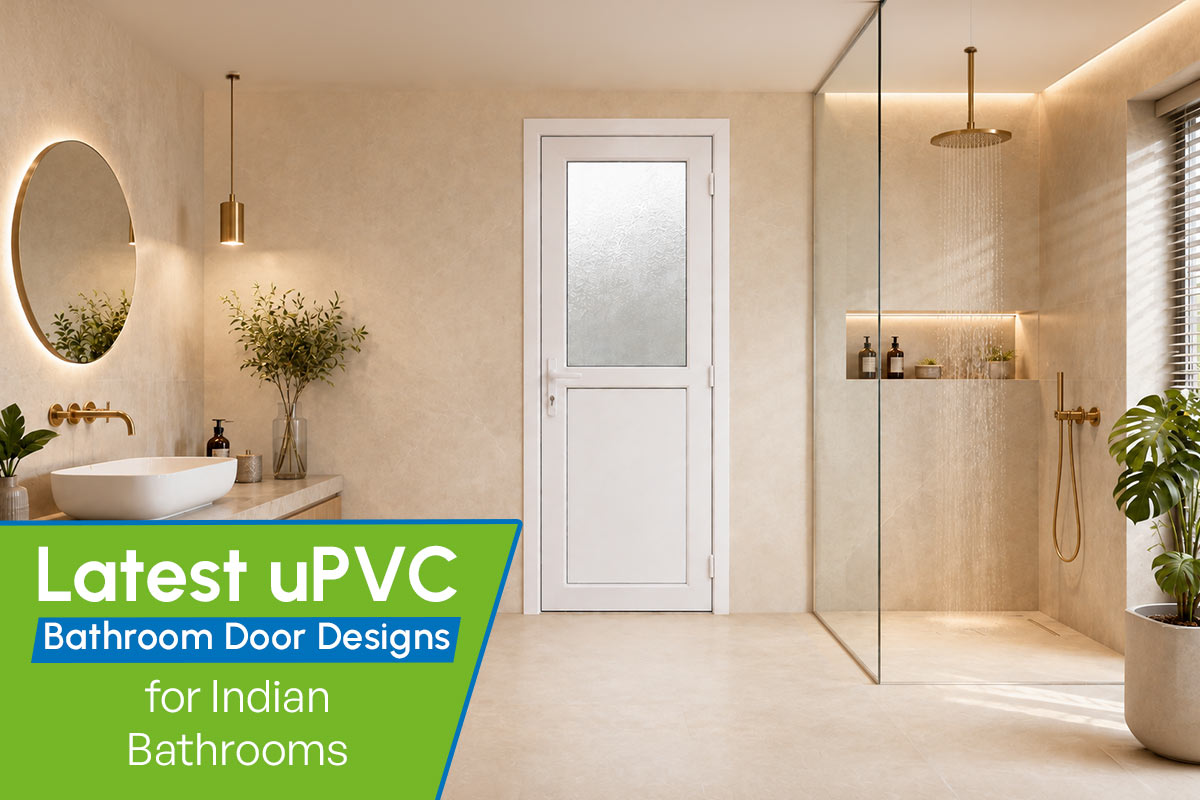
Latest uPVC Bathroom Door Designs for Indian Bathrooms
uPVC bathroom doors are waterproof doors made from unplasticised polyvinyl chloride (uPVC). As they do not absorb water, they are resistant to swelling, rotting, and warping. They are also termite-proof because uPVC does not contain cellulose and require very minimal maintenance, making them a perfect choice for Indian bathroom doors in apartments, villas, hotels, and coastal areas.
Bathrooms expose doors to constant moisture, steam, water splashes, and humidity. Unlike wood, uPVC does not absorb water, so it won’t swell, warp, rot or attract termites. This makes uPVC one of the most reliable bathroom door materials for Indian homes.
This guide explains what a uPVC bathroom door is, why it is better than wood and other materials, the door options Aparna Venster offers, and answers to some questions people need to know before buying.
Contents
- 1 uPVC Bathroom Doors at a Glance
- 2 What is a uPVC Bathroom Door?
- 3 Benefits of uPVC Bathroom Doors
- 4 How to Choose the Right uPVC Bathroom Door
- 5 uPVC Bathroom Door Options from Aparna Venster
- 6 uPVC Bathroom Door Specifications
- 7 uPVC vs. Wood vs. WPC: Which Is Best for a Bathroom?
- 8 Which Material Should You Choose?
- 9 Why uPVC Bathroom Doors Are a Smart Long-Term Investment
- 10 Why Choose Aparna Venster for uPVC Bathroom Doors
- 11 Common Mistakes to Avoid
- 12 Frequently Asked Questions
- 12.1 Are uPVC doors good for bathrooms?
- 12.2 How much does a uPVC bathroom door cost in India?
- 12.3 How long do uPVC bathroom doors last?
- 12.4 Can uPVC doors used for main or entrance door?
- 12.5 How to maintain a uPVC bathroom door?
- 12.6 Which glass is best for a bathroom door?
- 12.7 Are uPVC bathroom doors better than PVC doors?
uPVC Bathroom Doors at a Glance
- Best for: Bathrooms, utility rooms and wet areas
- Waterproof: Yes
- Termite resistant: Yes
- Maintenance: Minimal
- Typical lifespan: 20–30 years*
- Suitable for: Apartments, villas, hotels and coastal homes
Key Takeaways
- Fully waterproof and non-porous.
- Resistant to termites, moisture and mould.
- Requires no painting or polishing.
- Reinforced with galvanised steel for structural strength.
- Suitable for Indian bathrooms.
What is a uPVC Bathroom Door?
The full form of uPVC is Unplasticised Polyvinyl Chloride. It is a rigid, weather-resistant plastic engineered for structural use in doors and windows. uPVC must not be confused with PVC (Polyvinyl Chloride), which is a soft, flexible plastic used in pipes and sheeting. Unlike PVC, uPVC does not contain plasticisers, which are used to soften PVC.
Because uPVC is unplasticized, the material holds its shape permanently and does not bend in summer, nor does it swell from bathroom humidity. Aparna Venster manufactures its uPVC profiles on imported German machinery and reinforces its lead-free uPVC profile with a galvanized steel core, which gives the frame its structural strength and stability.
Benefits of uPVC Bathroom Doors
uPVC is the right material for your bathrooms because they are waterproof, moisture-resistant, durable, easy to maintain, termite- and pest-resistant, hygienic, provides thermal and sound insulation (when combined with glazing), and offers long-term value.
- Waterproof and Moisture-ResistantuPVC does not absorb water because it is non-porous. So splashes and steam stick on the surface and do not soak in. This eliminates the most common bathroom door issues like swollen edges, jammed shutters, warped panels, and softened cores.
- High Strength and Durability:
The galvanised steel reinforcement improves structural stability, helping the door maintain its shape during years of daily use.
- Low Maintenance
Unlike wood, uPVC does not require painting, polishing, or varnishing. Wiping the frame with a soft cloth and mild liquid detergent and giving the hardware a light annual cleaning is all that you need to maintain them.
- Termite and Pest Resistant
Bathroom wooden doors are a source of food for termites. uPVC profiles are completely termite-free in all climates, eliminating the long-term risk. This is because uPVC contains no cellulose or organic materials.
- Hygienic Surface
uPVC is non-porous, so they do not lead to the growth of moulds and bacteria. A door’s paint or polish develops tiny cracks over the years, allowing bacteria to accumulate. The surface of uPVC remains smooth for its full lifespan.
- Sound and Thermal Insulation
A double-seal system combined with insulating glass can cut noise levels by 30–40 dB. This becomes important when your bathroom shares a wall with a bedroom or living area. Also, the multi-chambered design of uPVC doors improves thermal insulation, which helps in keeping the bathroom more comfortable year-round.
- Fire and Weather Safety
uPVC acts as a fire retardant, and it doesn’t sustain or spread flame the way some other materials can. The profiles are also 100% lead-free (for some premium companies) and formulated to meet European Greenline environmental norms.
- Long-Term Cost Efficiency
The reduced maintenance and warranty from a reputed manufacturer help in cutting down the maintenance costs. This leads to savings in the long run.
How to Choose the Right uPVC Bathroom Door
Choose a sliding door for compact bathrooms, a casement door where ventilation is important, and a slide-and-fold door for larger bathrooms. Also consider privacy glass, hardware quality, colour options, and warranty before making your final decision.
uPVC Bathroom Door Options from Aparna Venster
You need to consider two factors before choosing the right door: privacy, natural light, and space in your bathroom. Venster offers sliding doors, casement doors, and slide and fold doors.
| Door Type | Description | Best For | Why Choose It |
|---|---|---|---|
| Sliding Bathroom Door | Slides sideways along a track without needing extra opening space. | Small bathrooms and compact spaces. | Saves space and does not obstruct bathroom fixtures. |
| Casement Bathroom Door | Opens inward or outward using side hinges. | Bathrooms with sufficient clearance. | Provides a wide opening, easy access and better ventilation. |
| Slide & Fold Bathroom Door | Slides and folds neatly to one side of the opening. | Large bathrooms and master suites. | Creates a wider opening and a seamless connection between spaces. |
Each of these can be customized with frosted or textured glass and finished in a range of colours and laminates to match your bathroom’s design.
uPVC Bathroom Door Specifications
This table displays the various specifications of uPVC doors for bathrooms:
| Feature | Technical Specification |
|---|---|
| Material Composition | Lead-free uPVC profiles reinforced with galvanised steel for added strength and durability. |
| Manufacturing | Manufactured using imported German machinery for precision and consistent quality. |
| Door Types | Sliding, casement, and slide-and-fold bathroom doors. |
| Colour Options | Solid colours and wood finishes including Golden Oak, Walnut, Rustic Oak, Dark Oak, and Mahogany. |
| Water Resistance | Waterproof and non-absorbent, making it suitable for moisture-prone bathroom environments. |
| Pest Resistance | Termite-proof and resistant to common pest-related damage. |
| Fire Safety | Fire-retardant material that does not readily support flame spread. |
| Sound Insulation | Provides up to 30–40 dB noise reduction when fitted with suitable double glazing and sealing systems. |
| Custom Sizing | Custom-made to fit different opening sizes, including bathroom entrances. |
| Structural Warranty | 10-year warranty against frame discolouration and deformation. |
| Hardware Warranty | Covers mechanical malfunction under normal usage conditions. |
uPVC vs. Wood vs. WPC: Which Is Best for a Bathroom?
| Feature | uPVC | Wood | WPC |
|---|---|---|---|
| Water Resistance | Excellent; waterproof and non-absorbent | Poor; can absorb moisture | Good moisture resistance |
| Termite Resistance | Excellent | Poor; requires protection | Excellent |
| Maintenance | Low | High | Low |
| Appearance | Modern colours and finishes | Natural wood grain | Wood-like finish |
| Sound Insulation | Good | Excellent | Good |
| Durability | Excellent | Moderate | Good |
| Moisture Protection | Excellent | Poor | Good |
| Cleaning | Easy to clean | Moderate | Easy to clean |
| Lifespan | Long-lasting | Moderate | Long-lasting |
| Cost | Low | High | Medium |
Wood is a good choice for dry rooms like bedrooms or studies. But for places like bathrooms, WPC offers better moisture resistance than wood but is generally heavier and more expensive than uPVC.
uPVC is a better choice because it resists water, comes in various colour options, and costs less than the other alternatives. For the best balance of performance and cost in a bathroom, uPVC is the clear choice.
Which Material Should You Choose?
| Material | Best For |
|---|---|
| uPVC Doors | Bathrooms, wet areas, and moisture-prone spaces. |
| Wooden Doors | Bedrooms, living spaces, and dry rooms. |
| WPC Doors | Bathrooms and wet areas where a wood-like appearance is preferred. |
Recommendation: For bathrooms, uPVC is the best choice because it is waterproof, termite-proof, easy to maintain, and built to last.
Why uPVC Bathroom Doors Are a Smart Long-Term Investment
Wooden bathroom doors create surface irregularities where bacteria and mould can settle. A uPVC bathroom door surface doesn’t change, so it remains free from bacteria and mould. This is helpful when you have toddlers and children. You can clean the door by wiping it down with a soft cloth.
Why Choose Aparna Venster for uPVC Bathroom Doors
Aparna Venster manufactures lead-free uPVC doors using imported German machinery and galvanised steel reinforcement, while providing measurement, fabrication and installation under one roof.
German manufacturing: Every profile is produced on machinery imported from Germany, and reinforced with galvanized steel.
Wide Range: Offers a wide range of bathroom doors, including sliding, casement, and slide-and-fold options, and suits all types of bathrooms (large and compact).
Warranty: Venster offers a 10-year structural warranty against discolouration and deformation. Besides, it also offers a 1-year warranty on hardware.
End- to-end Service: Aparna Venster handles everything from measurement to installation, offering peace of mind to customers by eliminating middlemen and vendors. This ensures strict quality control at every stage of manufacturing a bathroom door. It has its own manufacturing facility, where the final windows are produced under strict quality control, including fabrication.
Full customization: Doors can be customised into different sizes as per the requirement. Customisation is also available in colours, finishes and glass options.
Certifications: Venster’s manufacturing facilities operate under internationally recognised management systems that reflect our commitment to quality, environmental responsibility and workplace safety.
ISO 9001:2015 – Quality Management System
ISO 14001:2015 – Environmental Management System
ISO 45001:2018 – Occupational Health & Safety Management System
Common Mistakes to Avoid
- Choosing untreated wooden doors for wet areas.
- Ignoring galvanised steel reinforcement.
- Selecting poor-quality hardware.
- Buying without checking the warranty.
- Focusing only on price instead of long-term value.
Takeaway:
uPVC bathroom doors are a better choice for bathrooms because they do not get damaged by water and last a long. It also requires only minimal maintenance. If you’re renovating your bathroom, consider Aparna Venster’s uPVC bathroom doors, designed for long-term performance with minimal upkeep. Get in touch with the team to find the perfect door.
Frequently Asked Questions
Are uPVC doors good for bathrooms?
Yes. Their fully waterproof, termite-proof, non-porous surface is what a bathroom needs. They don’t swell, rot, or warp due to water or humidity. They’re also termite-proof and uPVC is easy to clean, making it a better choice than wood.
How much does a uPVC bathroom door cost in India?
Pricing depends on the door type (sliding, casement, or slide-and-fold), size, glass, and finish selected. Aparna Venster provides custom quotes based on your specific bathroom opening and requirements. Contact the team for an accurate quote.
How long do uPVC bathroom doors last?
uPVC doors are built to last for decades with minimal maintenance. Aparna Venster backs its doors with a 10-year structural warranty against discolouration and deformation. In general, uPVC doors last over 20 years with minimal maintenance and by following the manufacturer’s tips.
Can uPVC doors used for main or entrance door?
Yes, besides bathrooms, the uPVC door range, like slide-and-fold and casement styles, can be used for d larger entrance or balcony openings, depending on the design chosen.
How to maintain a uPVC bathroom door?
Wipe the frame with a soft cloth and mild liquid detergent solution. Clean and lightly grease tracks, hinges, and multi-point locks annually with petroleum jelly or machine oil. No painting, sealing, or pest treatment is ever required.
Which glass is best for a bathroom door?
Frosted or textured glass is the preferred choice because it provides privacy while allowing natural light into the bathroom. Laminated or toughened safety glass can also be selected depending on the application.
Are uPVC bathroom doors better than PVC doors?
Yes. uPVC is stronger and more rigid because it does not contain plasticisers. Unlike PVC, uPVC is designed for structural applications such as doors and windows, making it a better choice for bathrooms.
Related posts:
 Top 10 Bathroom Window Design Ideas for Indian Homes
 11 Balcony Window Designs That Actually Suit Indian Balconies
 How Multi-Chambered uPVC Profiles Reduce Indoor Heat in Indian Homes
 uPVC Window Designs for Homes: Types, Benefits and Buying Guide
 Top 10 uPVC Slide And Fold Door Ideas for Modern Homes in India
 English