
uPVC Steel Reinforcement for Windows & Doors: Types, Benefits & Applications
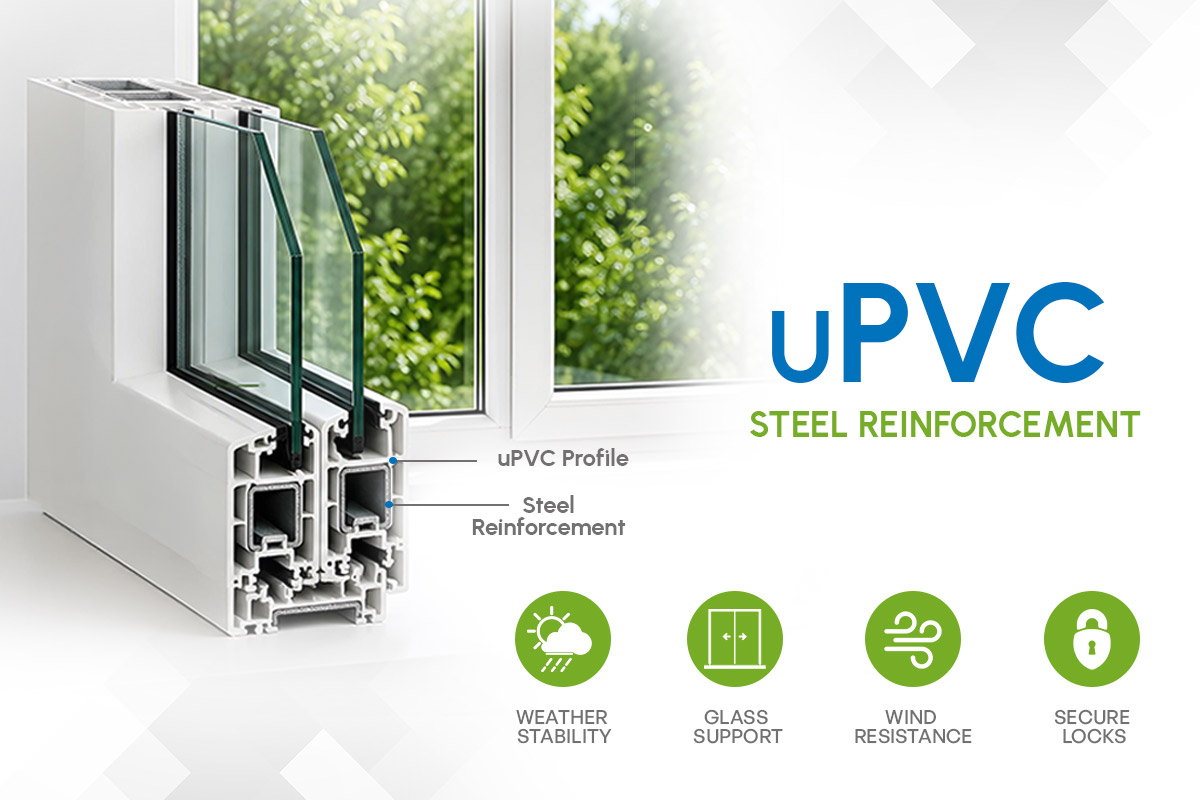
uPVC steel reinforcement — also known as galvanized iron (GI) reinforcement — is a galvanised steel section inserted inside the hollow chamber of a uPVC window or door profile. It provides structural rigidity, controls thermal expansion, supports heavy glass loads, and strengthens hardware fixing points such as hinges and multi-point locks.
uPVC windows and doors are widely used in residential, commercial, and architectural projects because they are easy to maintain, weather-resistant, offer thermal insulation, and provide design flexibility. However, as window and door sizes increase, the structural demands placed on the uPVC profile also increase.
This is where uPVC window and door reinforcements become important.
A proper steel reinforcement section works as an internal structural support within the uPVC profile. It helps maintain the shape of the profile, supports hardware fixing, and improves the overall stability of the finished window or door assembly.
Contents
- 1 What Is uPVC Steel Reinforcement?
- 2 Why Steel Reinforcement for uPVC Windows and Doors Needed?
- 3 uPVC Window Reinforcement: What Is It and Why Is It Important?
- 4 Applications of uPVC Window Reinforcement
- 5 uPVC Door Reinforcement: Why Is It Required?
- 6 What Is the Significance of uPVC Steel Reinforcement for Doors & Windows?
- 6.1 1. Improved Structural Stability
- 6.2 2. Controls Thermal Expansion and Contraction
- 6.3 3. Resistance to Bending and Deformation
- 6.4 4. Support for Heavy Glass
- 6.5 5. Better Wind-Load Performance
- 6.6 6. Stronger Hardware Fixing
- 6.7 7. Enhanced Security Against Forced Entry
- 6.8 8. Support for Larger Designs
- 6.9 9. Long-Term Dimensional Stability
- 7 How Does uPVC Steel Reinforcement Work?
- 8 What Are the Types of uPVC Steel Reinforcement?
- 9 Types of uPVC Steel Reinforcements
- 10 Types of uPVC Channel Profiles: Shapes, Functions and Applications
- 11 What Thickness Is Used for uPVC Steel Reinforcement?
- 12 Why Is Galvanised Steel Used for uPVC Reinforcement?
- 13 What Are the Benefits of Customised uPVC Steel Reinforcement?
- 14 What Factors Should Be Considered When Selecting uPVC Reinforcement?
- 15 Reinforced uPVC vs Hollow uPVC: What’s the Difference?
- 16 Where Is uPVC Steel Reinforcement Used?
- 17 uPVC Steel Reinforcement Manufacturer in Hyderabad, Telangana
- 18 Why Choose Aparna Venster for uPVC Steel Reinforcement?
- 19 Why Choose Reinforcement from Aparna Venster?
- 20 Frequently Asked Questions About uPVC Steel Reinforcement
- 20.1 What is uPVC steel reinforcement?
- 20.2 Why is steel reinforcement used in uPVC windows?
- 20.3 What is uPVC window reinforcement?
- 20.4 What is uPVC door reinforcement?
- 20.5 Do all uPVC windows require steel reinforcement?
- 20.6 What are the common uPVC reinforcement shapes?
- 20.7 What thickness is commonly used for uPVC steel reinforcement?
- 20.8 Why is galvanised steel used for uPVC reinforcement?
- 20.9 Are uPVC windows steel-reinforced actually stronger than standard frames
- 20.10 Does uPVC reinforcement support heavy glass?
- 20.11 Can uPVC steel reinforcement be customised?
- 20.12 How does customised uPVC reinforcement benefit fabricators?
- 20.13 Where is uPVC window reinforcement used?
- 20.14 Where is uPVC door reinforcement used?
- 20.15 Is box-section reinforcement suitable for uPVC windows and doors?
- 20.16 What is the significance of uPVC steel reinforcement for doors and windows?
- 20.17 How do I choose the right uPVC steel reinforcement?
- 20.18 Does uPVC steel reinforcement improve security against forced entry?
- 20.19 Does uPVC steel reinforcement help with thermal expansion?
- 21 Conclusion
Key Takeaways
- uPVC steel reinforcement is installed inside the hollow chamber of a uPVC profile
- It provides the required structural strength and rigidity
- It helps uPVC profiles resist bending, sagging, twisting, and deformation
- Reinforcement is important for large windows, tall doors, and heavy glazing systems
- Galvanised steel also offers corrosion protection
- Common reinforcement profiles include C channels, open-lip channels, box sections, step channels, and groove channels.
- Reinforcement thickness can vary according to the profile, dimensions, glass weight, wind loads, and application.
- Customised reinforcement sections can help fabricators reduce cutting and improve production efficiency.
What Is uPVC Steel Reinforcement?
uPVC steel reinforcement is a cold-formed galvanised steel section installed inside the hollow chambers of uPVC window and door profiles.
The reinforcement acts as an internal structural core, and the uPVC profile provides the external finish, weather resistance, and insulation characteristics. The steel section contributes additional rigidity and structural support.
The reinforcement section is selected according to the design of the uPVC profile and the requirements of the finished window or door.
Reinforcement may be manufactured in different shapes, dimensions, and thicknesses.
Why Steel Reinforcement for uPVC Windows and Doors Needed?
uPVC is a durable material, but window and door profiles can experience loads throughout their service life.
These loads may include:
- Weight of glass
- Wind pressure
- Hardware loads
- Repeated opening and closing
- Temperature-related movement
- External environmental conditions
As window and door dimensions increase, these demands can become more significant.
uPVC steel reinforcement provides additional rigidity to help the profile maintain its shape and structural stability under these conditions.
This is especially important for large-span windows, tall doors, sliding systems, and installations exposed to higher wind loads.
uPVC Window Reinforcement: What Is It and Why Is It Important?
uPVC window reinforcement is a steel section installed inside a uPVC window profile to provide additional structural support and rigidity.
Large windows carry heavy glass and face strong wind pressure. Without the right reinforcement, the profile can bend or deform — especially in bigger sizes.
A suitable uPVC window reinforcement channel helps support the profile and can also provide a stronger fixing base for hardware.
Applications of uPVC Window Reinforcement
uPVC steel reinforcement can be used in:
- Sliding uPVC windows
- Casement windows
- Fixed windows
- Large-span window systems
- Residential apartments
- Villas
- Commercial buildings
- Offices
- Architectural glazing systems
The required reinforcement depends on the profile system, window dimensions, glass configuration, wind-load requirements, and applicable design specifications.
uPVC Door Reinforcement: Why Is It Required?
uPVC door reinforcement is a galvanised steel section installed inside a uPVC door profile to improve its structural rigidity and stability.
Doors are subjected to repeated opening and closing, hardware loads, and large glass loads. Larger doors and glazed door systems can benefit from right internal reinforcement.
uPVC door reinforcement can be used in:
- Sliding uPVC doors
- Entrance doors
- Patio doors
- French doors
- Tall door systems
- Large glazed doors
- Commercial door systems
The reinforcement provides additional structural support and can also contribute to stronger fixing points for hinges, locks, handles, and other hardware.
What Is the Significance of uPVC Steel Reinforcement for Doors & Windows?
uPVC steel reinforcement strengthens doors and windows without changing the external appearance of the uPVC profile.
The main advantages include improved structural stability, controls thermal expansion and Contraction resistance to bending and deformation, heavy glass, better wind-load performance, stronger hardware fixing, support for larger designs, and long-term dimensional stability.
1. Improved Structural Stability
Steel reinforcement provides additional rigidity to the uPVC profile to help it retain its shape. This becomes very useful for larger window and door assemblies.
2. Controls Thermal Expansion and Contraction
uPVC expands and contracts more than steel when temperatures change. Without internal reinforcement, large profiles can bow, throwing off alignment and seal performance. The embedded steel core restrains this movement, keeping the profile dimensionally stable across seasonal temperature swings.
3. Resistance to Bending and Deformation
Reinforcement helps the profile resist bending, sagging, twisting, and other forms of deformation caused by loads and environmental conditions.
4. Support for Heavy Glass
Large glass panels can increase the load on a window or door profile.
An appropriately designed reinforcement section helps provide the structural support required for these larger glazing configurations.
5. Better Wind-Load Performance
Windows and doors are exposed to external wind pressure. Reinforcement increases profile rigidity and can contribute to the ability of the complete system to handle the design loads for which it has been specified.
6. Stronger Hardware Fixing
Steel reinforcement can provide a stronger substrate for fixing hardware such as:
- Hinges
- Locks
- Handles
- Fasteners
- Other window and door fittings
This translates into higher screw-holding strength, ensuring hardware stays securely anchored through years of repeated use without loosening.
7. Enhanced Security Against Forced Entry
Steel-reinforced uPVC profiles resist forced entry far better than hollow ones. The steel core anchors multi-point locks firmly, making it harder for intruders to force open the sash — an important consideration for ground-floor windows and entrance doors.
8. Support for Larger Designs
Modern architecture increasingly incorporates larger windows, wider openings, and tall glazed doors.
Appropriate reinforcement allows the uPVC profile system to accommodate these designs while providing the additional structural support required.
9. Long-Term Dimensional Stability
Maintaining profile geometry is important for proper operation. Reinforcement can help reduce deformation that may otherwise affect alignment, sealing, and hardware operation.
How Does uPVC Steel Reinforcement Work?
A typical uPVC profile contains one or more hollow chambers.
The reinforcement section is installed inside the appropriate chamber during the fabrication process.
The basic construction can be understood as:
uPVC outer profile → steel reinforcement inside the chamber → hardware and glazing → completed window or door assembly
The uPVC profile remains the visible component, while the steel reinforcement provides additional internal structural support.
The exact position and fixing method depend on the uPVC profile system and the manufacturer’s fabrication requirements.
What Are the Types of uPVC Steel Reinforcement?
Different uPVC profile systems require different reinforcement geometries.
Common types include Open Side Lip Channel (OSLC), Box Channels, Step Channels, C Channels, and Groove Channels.
Types of uPVC Steel Reinforcements
1. OSLC Shapes
- Profile: Open U-shape with deep-folded edge lips.
- Function: Stops thin metal from bending under high pressure.
- Applications: High-rise windows and heavy outer frameworks.
2. Open Lip Channels
- Profile: Standard U-shape with simple turned-in edges.
- Function: Leaves space for internal wiring and plumbing.
- Applications: Basic window framing and warehouse shelving.
3. Box Channels
- Profile: Fully closed square or rectangular tube.
- Function: Stops frames from twisting when slammed shut.
- Applications: Heavy sliding door sashes and large mullions.
4. Step Channels
- Profile: Stepped or offset zigzag shape.
- Function: Fits complex chambers without blocking water drainage.
- Applications: Premium multi-chamber windows and industrial flooring.
5. C Channels
- Profile: Simple U-beam with straight, smooth legs.
- Function: Slides easily into frames at low cost.
- Applications: Standard home windows and small sashes.
6. Grove Channels
- Profile: Steel track with a built-in center groove.
- Function: Lets window rollers and locks align perfectly.
- Applications: Sliding window tracks and locking gear paths.
Types of uPVC Channel Profiles: Shapes, Functions and Applications
uPVC channel profiles come in different shapes, each designed for a specific structural or functional purpose. Choosing the right channel type affects strength, drainage, wiring space and overall window or door performance. Below is a quick comparison of the six main uPVC channel profile types used in window and door manufacturing.
| Type | Profile Shape | Core Function | Primary Application |
|---|---|---|---|
| OSLC Shapes | Open with deep lips | Stops bending under high pressure | High-rise outer frames |
| Open Lip Channels | Open with simple lips | Leaves space for wiring/plumbing | Basic window framing |
| Box Channels | Fully closed tube | Prevents frame twisting | Heavy sliding door sashes |
| Step Channels | Stepped / Offset zigzag | Fits chambers without blocking drainage | Premium multi-chamber windows |
| C Channels | Smooth, straight legs | Slides easily at a low cost | Standard home windows |
| Grove Channels | Built-in center slot | Aligns rollers and locking gear | Sliding window tracks |
Which uPVC Channel Profile Should You Use?
- For high-rise buildings: OSLC shapes resist bending under structural load.
- For basic window framing: Open lip channels leave room for wiring and plumbing.
- For heavy sliding doors: Box channels prevent frame twisting with a fully closed tube design.
- For premium multi-chamber windows: Step channels fit chambers while preserving drainage.
- For standard home windows: C channels offer smooth, low-cost sliding performance.
- For sliding window tracks: Grove channels align rollers and locking hardware precisely.
What Thickness Is Used for uPVC Steel Reinforcement?
The appropriate uPVC steel reinforcement thickness depends on the application rather than being a single standard value for every window or door.
Common reinforcement thicknesses may range approximately from 1.0 mm to 2.5 mm, depending on factors such as:
- uPVC profile dimensions
- Window or door size
- Glass weight
- Wind-load requirements
- Building location
- Hardware configuration
- Profile chamber dimensions
- Fabrication requirements
The correct thickness must be selected based on the requirements of the complete window or door system.
Why Is Galvanised Steel Used for uPVC Reinforcement?
Galvanised steel is commonly used for uPVC reinforcement because it combines the structural strength of steel with zinc-based corrosion protection.
This reinforcement is sometimes referred to as GI (galvanized iron) reinforcement in the industry, distinguishing it from unreinforced or hollow uPVC profiles.
The zinc coating helps protect the steel substrate from corrosion.
Pre-sized reinforcement sections cut down on extra saw cutting during production.
The appropriate galvanisation level should be selected according to the expected environmental exposure and project requirements.
What Are the Benefits of Customised uPVC Steel Reinforcement?
uPVC profile systems are available in different dimensions and chamber configurations. So, a reinforcement section that fits one profile may not necessarily be suitable for another.
Customised uPVC steel reinforcement can be manufactured according to required dimensions, shapes and thicknesses.
This can provide several benefits for window and door fabricators:
- Better profile compatibility
- Reduced additional cutting
- Less fabrication work
- Lower material wastage
- Faster production
- Consistent dimensions
- Easier installation within the profile
- Improved manufacturing efficiency
When reinforcement sections are supplied according to the required dimensions, fabricators can reduce the need for additional saw cutting during production.
What Factors Should Be Considered When Selecting uPVC Reinforcement?
Choosing the right reinforcement requires consideration of the complete window or door system.
1. Profile Compatibility
The reinforcement must fit correctly inside the designated chamber of the uPVC profile.
2. Section Shape
The required geometry may be a box, C channel, open-lip, step, groove or another profile depending on the system.
3. Steel Thickness
Thickness should correspond to the dimensions and structural requirements of the application.
4. Window or Door Size
Larger assemblies generally require greater attention to structural reinforcement.
5. Glass Weight
Heavy or large-area glazing increases the load on the profile.
6. Wind Loads
The design wind pressure of the project should be considered when determining the appropriate reinforcement configuration.
7. Galvanised Coating
The zinc coating should be appropriate for the intended environment and durability requirements.
8. Dimensional Accuracy
Consistent dimensions and tolerances are important for proper fitment and efficient fabrication.
Reinforced uPVC vs Hollow uPVC: What’s the Difference?
| Feature | Reinforced uPVC (With Steel) | Hollow uPVC (No Steel) |
|---|---|---|
| Inside | Has a strong steel core | Totally empty plastic |
| Screws & Locks | Grip into steel; very secure | Grip into plastic; easy to break |
| Heavy Glass | Holds heavy glass easily | Sags and jams over time |
| Lifespan | Stays straight for decades | Warps and bends quickly |
Should You Choose Reinforced or Hollow uPVC?
- For heavy glass or large windows: Reinforced uPVC with a steel core holds weight without sagging.
- For long-term security: Screws and locks grip firmly into steel, reducing the risk of forced entry.
- For long-term durability: Reinforced profiles stay straight for decades, while hollow uPVC can warp over time.
- For budget, low-load applications: Hollow uPVC may suffice for small openings, but is more prone to sagging and hardware failure over time.
Where Is uPVC Steel Reinforcement Used?
uPVC reinforcement is used in residential, commercial, and architectural applications.
Residential Applications
- Apartments, villas, independent houses
- Residential renovations
- Large residential windows
- Patio doors
Commercial Applications
- Offices, commercial buildings, retail spaces
- Institutional buildings
- Hospitality projects
Window Applications
- Sliding windows
- Casement windows
- Fixed windows
- Large-span windows
Door Applications
- Entrance doors
- Sliding doors
- Patio doors
- French doors
- Tall glazed doors
- Large-format doors
uPVC Steel Reinforcement Manufacturer in Hyderabad, Telangana
Aparna Venster manufactures and supplies galvanised steel (GI) reinforcement sections for uPVC window and door fabricators across Hyderabad and Telangana, serving residential, commercial, and architectural projects throughout the region. Fabricators in Hyderabad can source customised reinforcement sections directly, reducing lead time and freight compared to sourcing from outside the state.
Why Choose Aparna Venster for uPVC Steel Reinforcement?
Aparna Venster manufactures galvanised steel reinforcement sections for uPVC windows and doors in customised sizes and varied thicknesses, in-house on its own machine.
The reinforcement solutions are designed for different fabrication requirements and can help provide structural support within uPVC profiles.
Key Product Features
- Galvanised steel reinforcement
- Custom-made sections
- Varied thickness options
- Multiple section configurations
- Dimensional accuracy
- Strong structural support
- Reduced requirement for saw cutting
- Improved fabrication efficiency
Venster also offers box-shaped uPVC steel reinforcement sections designed to provide internal structural support for uPVC windows and doors.
The company’s cold-formed manufacturing approach focuses on consistent dimensions, reliable section geometry, and quality-controlled production.
Why Choose Reinforcement from Aparna Venster?
For fabricators, reinforcement isn’t just a standard steel strip. It has to fit the profile and the fabrication process.
A customised reinforcement solution can help fabricators achieve:
Correct fit + consistent dimensions + reduced cutting + improved production efficiency
Venster reinforcement sections are manufactured to suit different profile requirements, helping fabricators streamline their production process.
Frequently Asked Questions About uPVC Steel Reinforcement
What is uPVC steel reinforcement?
uPVC steel reinforcement is a galvanised steel section installed inside the hollow chamber of a uPVC window or door profile to provide additional structural strength, rigidity and dimensional stability.
Why is steel reinforcement used in uPVC windows?
Steel reinforcement helps uPVC window profiles resist bending, sagging, twisting and deformation. It is especially important for larger windows, heavier glazing and applications subject to higher wind loads.
What is uPVC window reinforcement?
uPVC window reinforcement is an internal steel section used to strengthen uPVC window profiles. It supports the profile against loads and can provide stronger fixing points for window hardware.
What is uPVC door reinforcement?
uPVC door reinforcement is a steel section installed inside a uPVC door profile to improve structural rigidity and stability. It is particularly useful for large, tall or heavily glazed doors.
Do all uPVC windows require steel reinforcement?
Not necessarily. The requirement depends on the profile system, dimensions, glass weight, wind loads, and design specifications. Smaller systems may have different reinforcement requirements from large-format windows.
What are the common uPVC reinforcement shapes?
Common shapes include box sections, C channels, open-lip channels, step channels and groove channels. The appropriate shape depends on the uPVC profile and application.
What thickness is commonly used for uPVC steel reinforcement?
Common thicknesses may range approximately from 1.0 mm to 2.5 mm, depending on profile dimensions, glass weight, wind-load requirements, and the design of the complete system.
Why is galvanised steel used for uPVC reinforcement?
Galvanised steel provides the structural strength of steel along with zinc-based corrosion protection, helping the reinforcement remain durable in suitable applications.
Are uPVC windows steel-reinforced actually stronger than standard frames
Yes. Steel reinforcement provides additional structural rigidity inside the uPVC profile and can help the window or door assembly resist bending and deformation under specified loads.
Does uPVC reinforcement support heavy glass?
Appropriately designed reinforcement can provide additional structural support for uPVC profiles carrying larger or heavier glazing. The reinforcement should be selected according to the complete system requirements.
Can uPVC steel reinforcement be customised?
Yes. Reinforcement sections can be manufactured in customised shapes, dimensions, and thicknesses to suit different uPVC profile and fabrication requirements.
How does customised uPVC reinforcement benefit fabricators?
Customised sections can improve profile fitment, reduce additional saw cutting, minimise fabrication work, and help improve production efficiency.
Where is uPVC window reinforcement used?
uPVC window reinforcement can be used in sliding windows, casement windows, fixed windows, large-span window systems, apartments, villas, offices, and commercial buildings.
Where is uPVC door reinforcement used?
uPVC door reinforcement can be used in sliding doors, entrance doors, patio doors, French doors, tall doors, large glazed doors, and commercial door systems.
Is box-section reinforcement suitable for uPVC windows and doors?
Box-shaped reinforcement can provide good rigidity and resistance to bending and twisting. Its suitability depends on the dimensions and chamber configuration of the particular uPVC profile.
What is the significance of uPVC steel reinforcement for doors and windows?
The main significance is that reinforcement provides additional structural support to uPVC profiles. It helps improve rigidity, support heavy glazing, resist specified wind loads, provide stronger hardware fixing,ng and maintain dimensional stability.
How do I choose the right uPVC steel reinforcement?
Consider the uPVC profile, section shape, dimensions, steel thickness, glass weight, window or door size, wind-load requirements, galvanisation, and fabrication method. The reinforcement should be selected to suit the requirements of the complete system.
Does uPVC steel reinforcement improve security against forced entry?
Yes. Reinforced profiles anchor multi-point locking hardware more securely than hollow uPVC, making it harder for intruders to force open the sash or defeat the lock — an important factor for ground-floor windows and entrance doors.
Does uPVC steel reinforcement help with thermal expansion?
Yes. Because uPVC expands and contracts more than steel with temperature changes, the embedded steel core restrains this movement, helping the profile maintain its shape and seal performance across seasonal temperature swings.
Conclusion
uPVC steel reinforcement plays an important role in improving the structural stability and performance of uPVC windows and doors.
Steel reinforcements are important when window and door designs become larger, and glazing systems become heavier. So proper reinforcement can help provide the rigidity required to support the profile and maintain its dimensional stability.
The right reinforcement solution depends on the profile design and project requirements.
For fabricators, customised galvanised steel reinforcement offers an advantage because it reduces additional saw cutting and fabrication work.
Aparna Venster provides galvanised steel reinforcement sections in customised sizes and different thicknesses for uPVC window and door fabrication requirements.Get in touch with us today for your project requirements.
Related posts:
 uPVC Doors: Simple Guide to Types, Benefits and Uses in Homes
 What Are uPVC Doors? Types, Benefits & Maintenance
 What Is a uPVC Ventilator? Benefits, Types and Uses Explained
 uPVC Window Designs for Homes: Types, Benefits and Buying Guide
 Traditional vs uPVC Sliding Doors: Features, Benefits & Comparison
 English